INFERNAL REBIRTH INTO HELL: ILLUSIONS AND REALITIES
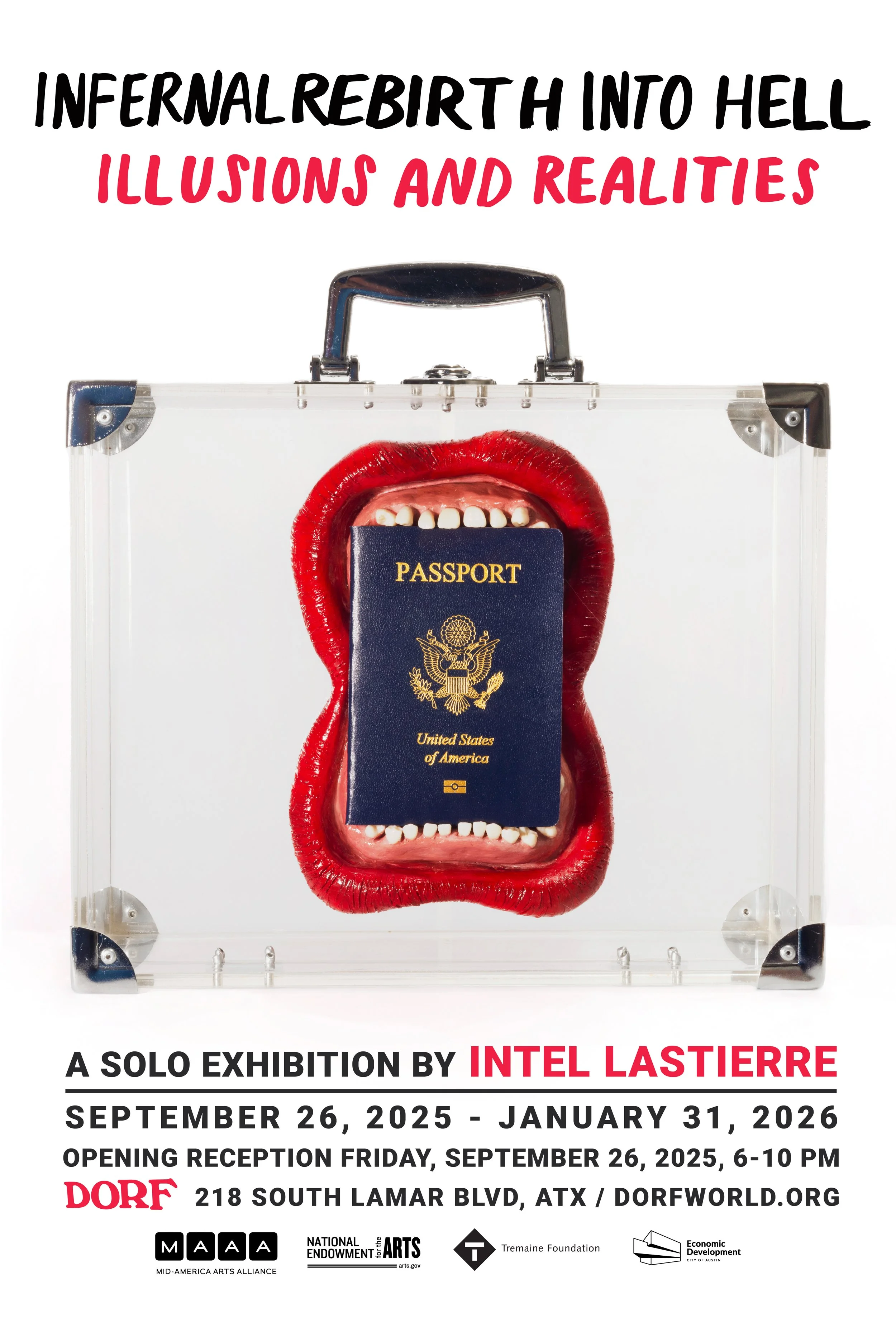
Infernal Rebirth into Hell: Illusions and Realities, Intel Lastierre’s latest solo exhibition, reveals the imperial paradox of the immigrant experience. Drawing on Plato’s Allegory of the Cave alongside mythological and historical references, Lastierre compels viewers to distinguish truth from the colonial propaganda of the American Dream.
In Lastierre’s interpretation of Plato’s allegory, the shadows in the cave represent the United States’ illusory promises: liberty, equality, and the opportunity to create a full life, regardless of who you are. But historically, these romantic ideas of a nation founded on freedom are a predatory comfort—mirages that simultaneously conceal and justify the violence of exploitative immigration policies in the United States. By comparing those who accept the shadows as reality to prisoners, Lastierre demonstrates the self-fulfilling trap encasing her people.
Konting tiis na lang. Just a little more suffering. Filipinos take cultural pride in resilience, but in oppressive hands, this pride is manipulated into a tool of compliance; the chains that keep the prisoners docile in the cave. For generations, the United States has stolen Filipino labor, resources, and lives, creating a cycle of economic displacement and perpetuating a reliance on opportunities abroad, where migrants are indiscriminately surveilled, detained, and deported. While the United States exerts influence over the Philippines’ government through their insidious brand of democratic corruption, the current Filipino puppet president unquestioningly offers his own people to the altar of his ousted father’s greedy dictatorial legacy. With over a tenth of Filipinos working overseas because life at home is insupportable, Lastierre asks: at what point will migrants stop chasing phantasmal shadows and resist the intentional design of their oppression?
Through large-scale paintings, sculptures, and immersive installations, Lastierre rejects the capacity to suffer as a solution for systemic exploitation. Balikbayan: Boxes of Longing is a poignant portrayal of diasporic grief, stacking 16 balikbayan boxes—care packages symbolizing self-sacrificing love despite separation—into a canvas inspired by Théodore Géricault’s The Raft of the Medusa. Popularized in the 1980s by overseas Filipino workers, balikbayan boxes are named for their function: to return to the country. As Lastierre’s largest installation to date, Balikbayan demonstrates not only the physical journey of migration but also the ubiquity of Filipino displacement. The painting itself abstracts the human form while maintaining realistic textures of the flesh, creating figures that are tangible yet anonymously universal. Similarly to its inspiration, Balikbayan portrays death in the lower left corner and recalls the cannibalism on the original raft. Lastierre’s interpretation, however, is less literal and more esoteric, comparing cannibalism to the destruction of native culture and identity that America demands from migrants as the only way to assimilate and survive.
Created as a personal chronicle of Lastierre’s own disillusionment, Infernal Rebirth into Hell challenges us to escape the cave by questioning: who is a necessary sacrifice and who is worthy of a dignified life? Who gets to decide?
— Regine Malibiran Curatorial Fellow Statement
“Gods, Vows, and Violence”
A solo exhibition by Intel Lastierre
Exhibition Statement:
In “Gods, Vows, and Violence” Intel Lastierre reimagines mythological narratives to interrogate the enduring cycles of patriarchy, colonialism, and gender-based violence. The exhibition showcases six powerful paintings of iconic female figures from Greek mythology: Medusa, Cassandra, Persephone, Iphigenia, Andromeda, and Philomela. These women are traditionally seen as symbols of suffering and sacrifice. Lastierre’s work reframes these figures, transforming them from passive victims into active agents of resistance, reclaiming their narratives as a direct response to the contemporary struggles of Filipinas trapped in abusive and oppressive marriages.
The exhibition draws particular attention to the intersection of legal and cultural structures that continue to disenfranchise women in the Philippines. Despite the country’s pre-colonial history of divorce as a mutual and practical practice, the colonial imposition of Catholic doctrines reshaped marriage into a sacred, indissoluble contract, stripping women of their rights to autonomy and personal agency. In the present day, divorce remains illegal, and annulments are an inaccessible alternative for many. Lastierre’s work critiques this legacy of colonial violence, shedding light on the legal and societal forces that keep women bound in harmful relationships. For Filipinas, the need for divorce legislation is not merely a legal issue. It’s an act of decolonization, a reclaiming of the freedoms that were taken away under colonial rule. It’s about reconnecting with pre-colonial values that honored personal agency and mutual respect within relationships.
In each of the mythological figures depicted in the exhibition, Lastierre identifies a parallel to the lived experience of women in the Philippines today. Medusa symbolizes women blamed for the failure of their marriages; Cassandra speaks to those whose cries for help are ignored by institutions; Persephone embodies those trapped in cycles of abuse; Iphigenia represents women sacrificed for the sake of family honor; Andromeda mirrors women used as social or economic pawns; and Philomela reflects the survivors who turn to art as a form of reclaiming their voice and autonomy. These figures, while rooted in ancient mythology, serve as contemporary allegories for the complex realities of women’s lives under systems of control.
Weaving mythology with present-day injustices, this exhibition challenges the patriarchal structures that reinforce the romanticized notion of sacrifice and endurance. It’s not just about retelling these myths. It’s about transforming these stories into a call for awareness and action. Through this exhibition, Lastierre hopes to inspire a reflection on the importance of creating a society where women are no longer bound by invisible chains.It is time for a culture that values individual well-being over outdated traditions and embraces the freedom to make choices that honor one's life, just as our ancestors once did.

PARTY LINE
An Art Exchange Exhibition between Tiger Strikes Asteroid Greenville & ICOSA Collective
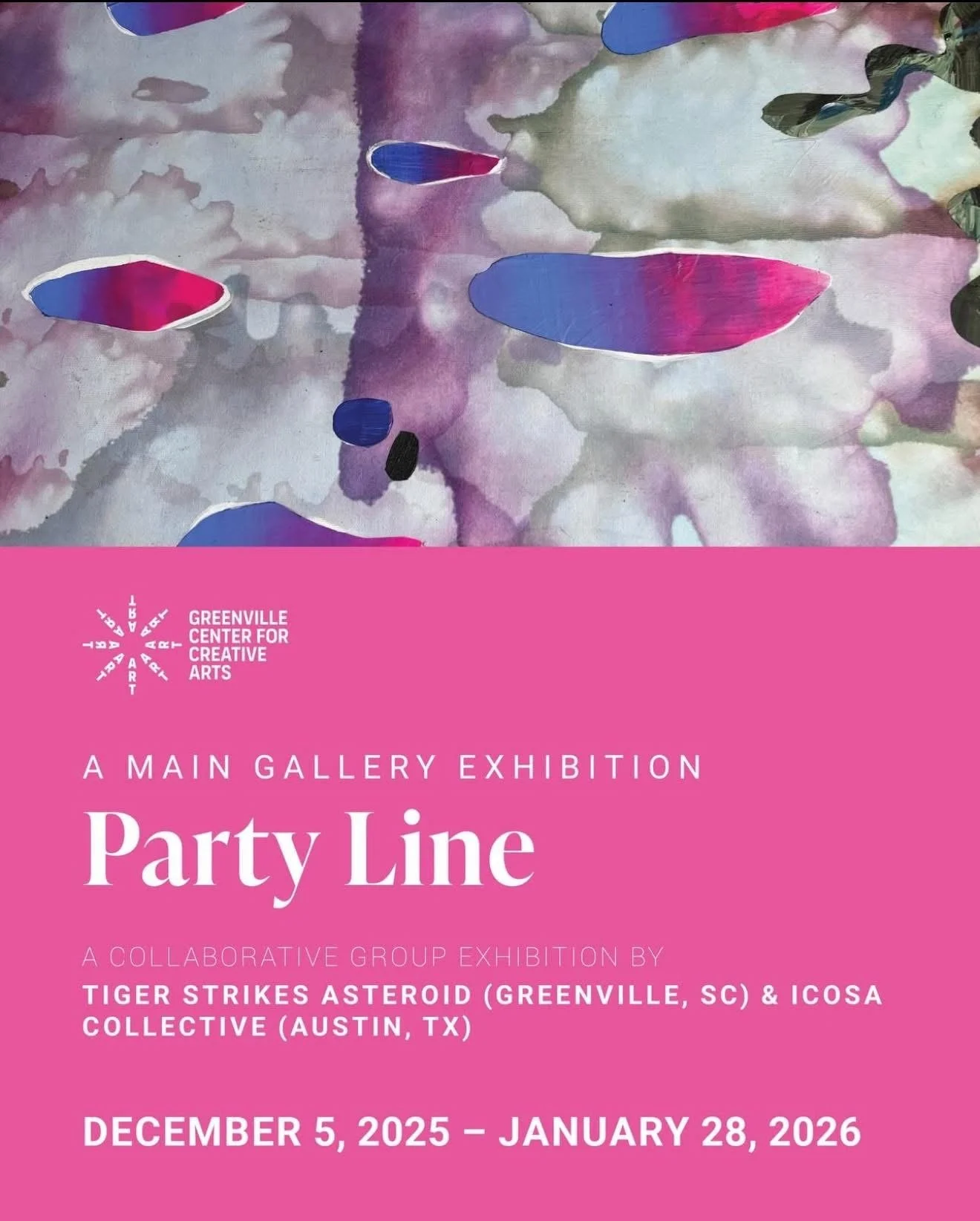
Party Line is a collaborative group exhibition linking 42 artists between both artist collectives - TSA GVL in Greenville, SC and ICOSA Collective in Austin, TX - through a series of experimental artist pairings. Working across geography and media, each pair was randomly matched and invited to engage with a shared curatorial theme built around communication, connection, and collaboration across distance.
Inspired by the idea of a shared telephone network, Party Line reimagines a shared channel for today’s mode of communication, suggesting new ways of working together across cultural, political and regional divides. The results span responsive gestures, new site-specific works, and sustained cross-dialogue that reflects tension and synchronicity.
While the exhibition celebrates exchange, it also contemplates what it means to collaborate in the wake of disruption. These works arise not from agreement, but from the willingness to stay connected - even when the line cracks, the message distorts, or silence lingers.
Participating Artists:
Leon Alesi, Mauro Barreto, Megan Bickel, Michael Borowski, Kiley Brandt, Sterling Bowen, Michaela Pilar Brown, Shawn Camp, Veronica Ceci, Zen Cohen, John Cummings, Erin Cunningham, Katherine Van Drie, Adam Eddy, Rebecca Forstater, Rosie Ganske, Ariana Gomez, Sarah Hirneisen, Kevin Kao, Intel Lastierre, TJ Lemanski, Chantal Lesley, Hirona Matsuda, Amanda Linn McInerney, Monica Mohnot, Charlie Mura, Juliette M.M. Herrera Nickle, Vy Ngo, Claudia O’Steen, Jacqueline Overby, Dana Potter, Ashley Rabanal, Matt Rebholz, Seth Relentless, Tammie Rubin, Alex J. Schechter, Joseph Smolin, Leah Smolin, Brooks Harris Stevens, Ana Trevino, Lana Waldrep-Appl, Jenn Wilson Shepherd
Participating Organization:
Tiger Strikes Asteroid Greenville- Greenville, South Carolina
About TSA GVL
Tiger Strikes Asteroid (TSA GVL) is a 501c3 non-profit network of independently programmed, artist-run exhibition spaces with locations in Philadelphia, New York, Los Angeles, Chicago, and Greenville, SC. Our goal is to collectively bring people together, expand connections and create community through artist-initiated exhibitions, projects, and curatorial opportunities.
ICOSA Collective - Austin, TX
About ICOSA Collective
ICOSA is a network of artists committed to providing exhibition space free of the constraints of the traditional gallery model, as well as a platform for dialoguing with audiences. ICOSA’s culture empowers artists to develop their creative and professional ambitions, continuously culminating in a wide range of events, from art shows to educational programs, as well as in cooperative partnerships with diverse organizations.
ICOSA’s programming ignites ideas and relationships between the Austin and global art communities: compliments of its member artists who are producing some of the region’s highest-caliber contemporary art and art discussion. ICOSA preserves a sustainable lifestyle for local artists and engages in dialogue with art lovers throughout the region and beyond.